Many teams think data governance is just a checklist for audits and compliance, something they must do but never something they get excited about. The truth is more interesting because strong governance can help businesses create better ideas and make faster decisions. Snowflakes give companies a smart way to control data while also giving people freedom to use it for new growth. As more enterprises move toward Snowflake’s cloud native setup, they notice how its governance capabilities and smart partner solutions like Select Star help them stay secure without slowing down progress. This changes the mindset. Governance turns into a strength that supports innovation instead of blocking it.
What is Data Governance
People use this word in many different ways inside data engineering. Sometimes it feels too broad or confusing. At its core, data governance is how an organization sets up the right methods and habits to manage its data and all the information connected to it. This includes making sure data is available when someone needs it, keeping its quality trustworthy, and keeping everything secure from unauthorized access.
There are many layers of governance in total. It can become very wide and sometimes complex. For now, we only focus on a few layers that matter most for this topic.
Good governance keeps changing with the company. It never stays fixed. New teams join, new systems arrive, old processes stop working. So, data stewards keep checking what is already in place, and they talk to business users to learn what controls are still needed. They also track how well those controls are working across the Business and update them when they start to fall behind.
Why Data Governance is Important
Strong governance makes sure data stays trustworthy throughout its full journey in Business. It covers the moment data gets created or captured and continues through every transformation or advanced use case, like machine learning predictions. When the same rules and standards guide everyone, the information used for decisions becomes clearer and more dependable. Leaders can trust the numbers. Customers get the correct communication. Users feel confident using data for daily tasks.
Without proper governance, many small issues slowly build up and later become expensive problems. Some of the common trouble areas include.
- Customer details are stored in different formats, leading to confusion during consolidation.
- Duplicate records that hide the truth about customers or products
- Data quality gaps that stop teams from getting accurate insights
- Time zone mismatches or missing fields that affect reporting and analysis.
- Manual cleanup work that reduces productivity and delays decisions
A well-managed governance practice keeps data clean and consistent, which supports better business outcomes.
Snowflake Built-in Data Governance Capabilities
Rules for data protection keep changing across the world with things like GDPR, HIPAA, and CCPA. Companies feel the pressure to keep data safe while still using it for growth. Snowflake helps them handle these responsibilities in a smart way. Its platform gives control so data stays protected and still useful for the business.
Snowflake includes a strong set of features that help teams manage who can see what without slowing them down. The goal is simple. Right people access the right information at the right moment.
Object Tagging
- Teams attach key value tags to tables, columns, and views, which helps them clearly classify data and keep track of sensitive information inside the warehouse
- These tags help drive access rules and automated controls that make governance easier to manage and monitor across many users
- Overall, it creates a better structure so people can find the right data quickly without confusion
Dynamic Data Masking
- Sensitive fields stay protected because Snowflake checks a user’s role during query time and then shows only what their level of permission allows them to see
- Teams can create custom masking rules for different data types so the information still looks useful, but private details remain hidden unless someone has the right authority
- It supports a balance where security remains strong while work continues without blockers for authorized users
Row Access Policies
- These rules limit what rows a person can view or modify, which helps protect private or restricted information, even inside the same table
- It works during select, update, delete, and merge operations, so the system maintains consistent control over every type of access
- Teams can design policies based on roles or regions, or departments, so people only see information that fits their responsibilities
Learn More – A Comprehensive Guide to Migrate Legacy Data Warehouses to Snowflake
Audit Logs
- Snowflake tracks user actions and data movements, which gives visibility into who accessed what and when they did it
- Logs help prove compliance during audits and investigations because they show a clear history and data lineage through the entire system
- It supports accountable operations since any unusual behavior can be detected and addressed early
Governance vs Compliance in Snowflake
Governance inside Snowflake is a complete framework that protects the quality and lifecycle of data. It includes all the rules and everyday habits that help manage information securely while keeping it useful for the Business. It looks after the value of data by focusing on security, accuracy, and smart access control.
Compliance focuses on following external rules like GDPR or HIPAA. It is important, but it only covers one part of the bigger picture. Snowflakes include features that support these legal needs while letting teams work with data freely when allowed.
| Aspect | Governance | Compliance |
| Focus | Data quality, lifecycle controls, and access management | Regulatory requirements such as GDPR, HIPAA, and CCPA |
| Goal | Maintain the integrity and value of data across the organization | Avoid penalties and meet legal obligations |
| Measurement | Data reuse percentage, faster resolution of issues, and stronger adoption | Pass or fail audits, number of violations |
| Tools | Object tagging, lineage visibility, and role-based access policies | Audit logs, compliance reports, predefined policy checks |
| Business value | Better efficiency, trusted data for analytics and AI, and higher innovation | Baseline protection and regulatory safety |
Beyond Compliance Checklists
Compliance is always important for a business. Still, Snowflake makes governance useful in a much wider sense. It supports better data quality, strong lifecycle controls, and smart access rules that help people use information with confidence. Once companies stop looking at governance as only a rule to follow, they start seeing the real benefits.
Operational Efficiency
- Tags and role-based access in Snowflake prevent teams from making unnecessary copies of the same dataset
- Everyone works on governed data instead of creating separate versions that later become difficult to maintain
- Automated processes reduce the manual load on teams, which saves cost and time
Innovation with Trusted Data
- When the Business knows data is accurate and updated, leaders feel safe to use it for analytics and AI programs
- Governance features keep insights reliable, so they support better decisions
- Lineage visibility through partner tools helps track the information back to where it started, which avoids wrong results caused by hidden data issues
Learn More – Maximize Data Potential with Matillion and Snowflake Integration
Customer Trust
- When users know their information is handled carefully, they feel more comfortable working with that brand
- Strong governance builds a reputation that the company takes responsibility for data privacy
- It becomes easier to work with partners since everyone sees clear control and transparency
The more governance becomes a part of everyday data practice, the more it helps the business grow. It speeds up decision-making and opens space for new ideas without putting security at risk. Good governance becomes a strength that helps businesses move ahead with trust.
Build a Governance Framework in Snowflake
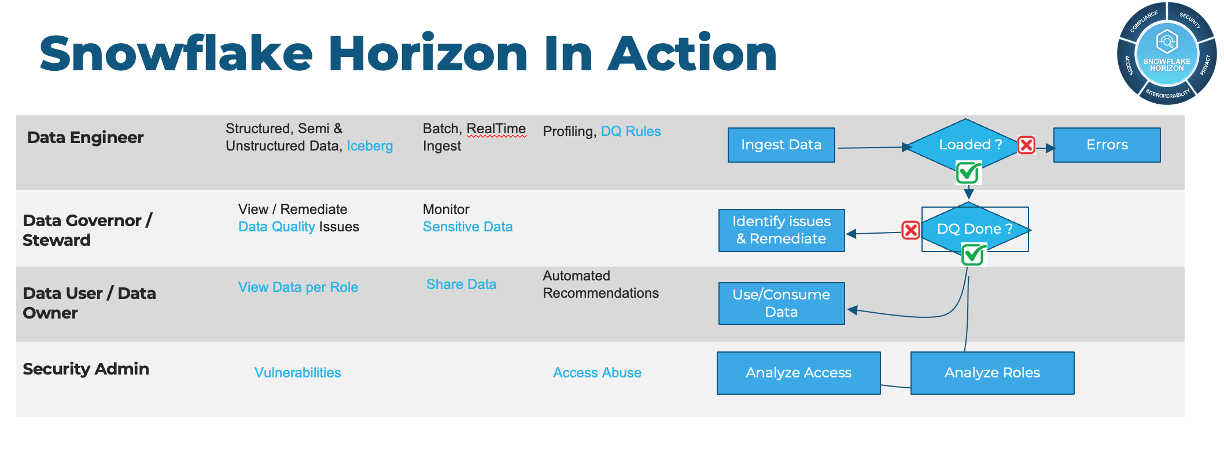
A strong governance program in Snowflake needs a planned approach that grows in the right direction. Each step adds structure and clarity to how data is managed.
Source: Snowflake
Environmental Analysis
- Start with full visibility into the landscape inside Snowflake, including where data comes from, how it moves, and which teams depend on it
- Mapping sources, sets, types, and flows helps discover risks and also reveals how different systems connect
- This understanding becomes the base that supports the next governance decisions
Policy Design
- Create controls that support business goals so governance adds value instead of adding blockers
- Define what the business wants to improve, such as security, lifecycle, or access clarity
- Use a known governance model like the Data Management Body of Knowledge or a mesh design as a reference to guide structure, rules, and ownership
Team Structure
- Form a group that takes responsibility for data governance efforts and decision-making
- People involved usually include data stewards, managers, custodians, compliance experts, architects, security professionals, and data quality analysts
- Each role looks after a different part of the data journey, so no areas are ignored, and accountability remains clear
Metrics for success
- Success can be measured by how fast issues are fixed and how much duplicate data is removed from storage
- Progress can also be seen in the percentage of tables that carry proper tags, which makes governance easier to automate and monitor
- Strong metrics help show the business impact, which keeps leadership support high
Enhance Data Governance in Snowflake with Stridely
Good governance is not just a set of rules to follow. It is a smart way to protect data while turning it into a real business advantage. Snowflakes already give the right foundation that keeps data secure and easy to use. Still, many organizations need a partner who understands how to set the right controls and make everything work smoothly together.
Stridely has hands-on experience with Snowflake projects where data quality, access rules, and compliance expectations are high. Our teams help build tagging strategies, implement masking, and row access rules, and bring visibility across systems. Contact us today for Snowflake Data Governance.
Frequently Asked Questions
What is Snowflake data governance?
It is a set of rules and everyday practices inside Snowflake that take care of data quality, secure access, and lifecycle control. The goal is to make sure information stays trusted and still usable for everyone who depends on it.
Why do companies need governance if they already focus on compliance?
Compliance only checks if the organization follows the law. Governance helps the business use data in a smarter way. It improves accuracy, reduces manual work, and builds a sturdy base for analytics and AI programs.
How does Snowflake protect sensitive information?
Snowflake supports governance with capabilities like object tagging, dynamic data masking, row access rules, and audit trails. These controls keep private details hidden from people who should not see them and still allow approved users to get their work done.
Is governance a one-time project?
No. Governance keeps changing because the business keeps changing. New data has arrived. New teams join. New regulations are coming. Governance must grow and improve with the organization.
Who should manage governance inside a company?
A governance team often contains stewards, security specialists, architects, and quality analysts. Each role oversees a different responsibility, so the system stays balanced, and nothing gets ignored.
Can partners help accelerate governance setup in Snowflake?
Yes. Partners with Snowflake experience can set up rules faster and guide the structure based on proven practices. They help avoid mistakes that slow down value creation.