Overview
Stridely Solutions partnered with a leading American manufacturer in the commercial and industrial setting for SAP ECC to SAP S/4HANA migration. It was a huge transition for the business to overcome aging infrastructure challenges. The transition enabled them to leverage intelligent automation, real-time analytics, and improved system performance, ensuring scalability and innovation in their industry.
The Client
The client is a leading American manufacturer in Industrial and commercial settings. They are a renowned name and collaborate with utilities, industrial manufacturers, building operators, and communities to optimize and protect water resources.
Challenges
The client faced several key challenges:
End of ECC Support: SAP’s announcement of ECC support ending by 2030 necessitated an upgrade.
- SAP’s announcement of ECC support ending by 2030 necessitated an upgrade.
- The system lacked modern UI and intelligent features like AI, machine learning, and predictive analytics.
- Over a decade of accumulated outdated code led to slow performance.
- ECC relied on traditional relational databases, restricting efficient large-scale data management.
- The existing system could not support real-time, data-driven decisions.
Solution
Stridely Solutions provided a comprehensive SAP S/4HANA migration service using the Brownfield Approach, ensuring minimal disruption and quick adoption. Our methodology included:
-
Brownfield Approach
Migrated the database to SAP HANA and upgraded applications to S/4HANA while retaining existing business processes.
-
Data Transition Validation (DTV)
Verified financial data accuracy before and after migration to ensure a smooth transition.
-
Smart Shift Integration
Leveraged automation to eliminate redundant code, reducing manual effort and enhancing system performance.
Results
Bottom Line
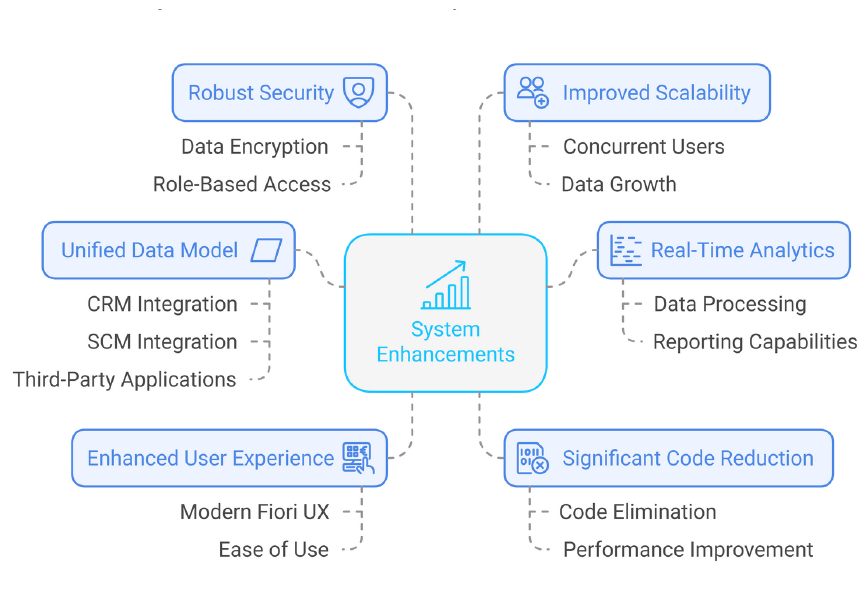
Migrating from ECC to SAP S/4HANA delivered significant value through automation-driven efficiencies. Automation of user access reviews cut time, effort, and costs by 30%, while automated revenue plan updates made resource planning 2,500 times faster. Data volume was reduced by 70%, enhancing performance and lowering storage costs. The transition also eliminated over 4,000 obsolete programs and custom objects, simplifying system maintenance, and archived eight years of financial data, reducing technical debt. These automation-led initiatives streamlined operations, optimized costs, and improved overall system performance.